
Why Your Project Won’t Sit Square—and How to Check It
Separate a racked frame, a twisted assembly, and an uneven support surface before trying to fix the fit.

A crooked-looking assembly can have more than one cause. Before forcing a corner into place, find out whether the parts, the joints, or the surface underneath them is creating the problem.
01 / WORKSHOP PRACTICECheck the surface underneath
Put the assembly on a suitable flat reference surface and look for rocking. A warped bench top or a chip beneath one corner can make a sound assembly appear twisted. Clean the support area and check it before altering the project.
If a small table rocks on the floor, move it and compare the behavior on a known flat surface. Do not shorten a leg until you have established where the error lies. A floor problem and a leg-length problem call for different responses.
02 / WORKSHOP PRACTICECompare the parts and joint seating
For a simple rectangular frame, compare the intended matching members. Check their lengths and inspect the mating surfaces. Make sure the joints are seated correctly and no trapped debris or incorrect orientation is holding a corner open.
A joint that needs excessive force during a dry fit deserves investigation. Verify the dimensions and the joint design. Clamps can hold an assembly while it is checked, but they should not be used to conceal a machining error that will remain under stress.
03 / WORKSHOP PRACTICEUse diagonals with the right assumptions
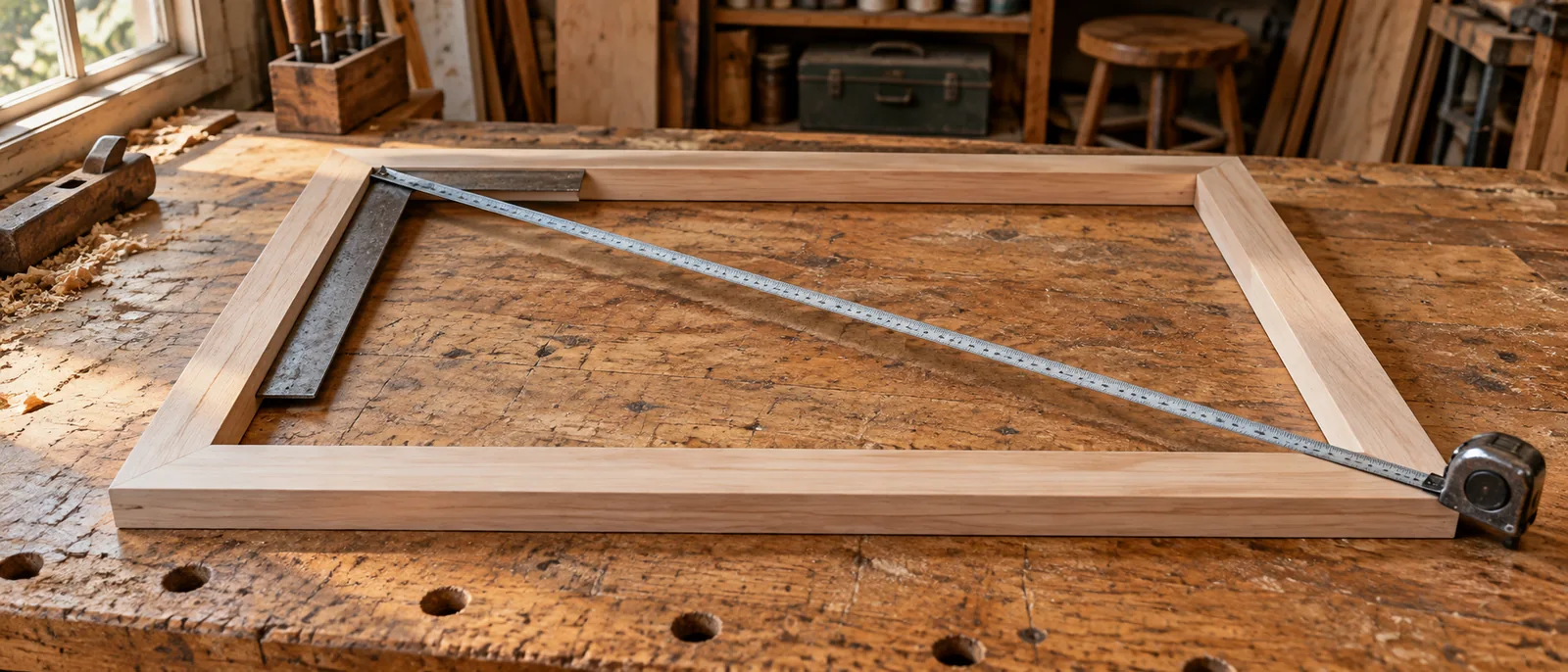
On a flat rectangular frame, measure between the same corresponding corner points in both directions. Unequal diagonals indicate that the intended rectangle needs further checking. Use repeatable measuring points rather than an outer corner on one diagonal and an inner corner on the other.
Equal diagonals alone do not prove that every four-sided shape is a rectangle. Confirm matching opposite sides and inspect the corners with a reliable square as well. Also check that the frame lies in one plane; a twisted assembly can pass one measurement and still cause trouble.
04 / WORKSHOP PRACTICERecheck as the assembly comes together
Follow the plan's assembly sequence and check alignment as clamps are tightened. Watch for a corner lifting or a joint moving out of position. Keep the support stable and use pressure appropriate to the joint and adhesive instructions.
Do these checks before a fixed back, permanent fasteners, or cured glue locks the geometry in place. If the assembly is already cured, first identify the actual fault. Pulling hard on it or trimming a random edge is not a substitute for understanding what went wrong.
Your workshop checklist
Tick these off as you prepare. Checks reset when you reload.
Square is a set of relationships between parts. Check those relationships while you can still adjust them, and the next stages of the build become much easier.
Make it a great day in the shop.